
Reader summary
Four points to keep
- A cart estimate is provisional until packed weight and dimensions are known.
- Remove unnecessary volume only after checking product protection and returns.
- Compare consolidation with separate parcels using complete totals.
- Apply a coupon after verifying route eligibility, thresholds and exclusions.
FACT-CHECK NOTE
Start while the items are still in the cart
If you are asking how to reduce a parcel price while everything is still in the shopping cart, distinguish a planning estimate from a warehouse quote. The final outer carton, protective material and measured weight may not exist yet. Record destination, item types, estimated weights and any bulky retail packaging. Use that information to identify expensive uncertainties rather than treating the estimate as a confirmed bill.
Remove unwanted duplicate items before paying for them. Check whether a large object is essential to the order and whether its dimensions restrict the available routes. A cheap product can be expensive to transport when it occupies a large box. Keep the product budget and international shipping budget separate. If the only affordable plan depends on a packing change that has not been confirmed, ask about that change before purchasing.
Find out which weight is being charged
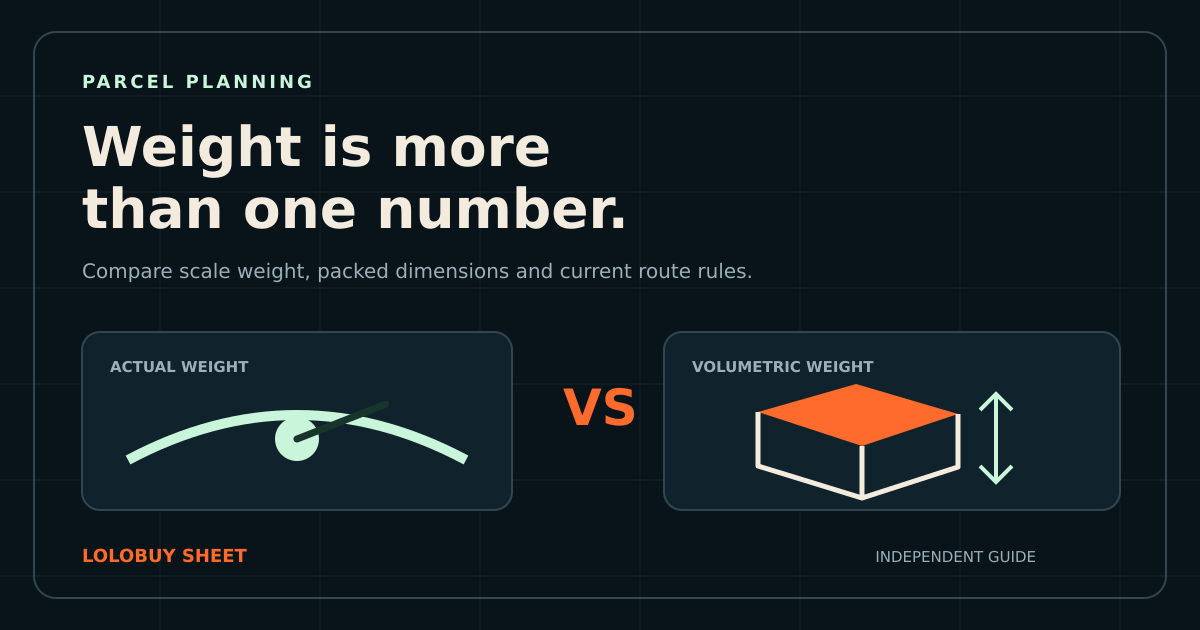
Copy the live route’s weight formula, units, rounding increment and minimum charge. Where a route uses volumetric weight, multiply the packed length, width and height in the required units and divide by the stated divisor. Compare that result with actual weight using the route’s own rule. Do not assume that every route uses the same divisor or that the advertised kilogram price includes its initial charge.
For a calculation example only, a 40 × 30 × 25 cm carton occupies 30,000 cubic centimetres. With a hypothetical divisor of 5,000, its volumetric weight is 6 kg. If the actual weight is 4 kg and the route bills the higher figure, volume drives the charge. Those numbers explain a mechanism; they are not LoloBuy rates, a live quote or a claim that a particular route is available.
Compare a realistic packing change
Using the same illustrative parcel, reducing the height from 25 to 20 cm changes volume to 24,000 cubic centimetres and calculated volumetric weight to 4.8 kg. A route rounding upward to half-kilogram steps would bill 5 kg rather than 6 kg, assuming that actual weight and the other rules remain compatible. The saving in money still depends on that route’s tariff and any repacking charge.
Ask the warehouse whether the proposed dimensions are achievable without harming the contents. Record a before-and-after quote using the same destination and route. This makes the comparison attributable to packing instead of a changed service. If the quote already uses actual weight, reducing empty space may not lower its chargeable weight. It could still affect eligibility, but it should not be presented as a guaranteed discount.
Decide what packaging can safely be removed
Retail boxes, redundant seller wrapping and empty space are different from protective material. Before removing a shoe box, consider whether the footwear needs structure protection and whether the box is required for your own purposes. For delicate accessories, shaped bags or hard components, indiscriminate compression may create damage. Keep labels and packaging needed for an unresolved return until that issue is settled.
Give item-specific instructions. A request to remove redundant outer wrapping while retaining necessary protection is clearer than asking for the smallest possible package. Ask whether the requested service is available and whether it changes cost or dimensions. Save the instruction and the resulting packing information. Do not claim packaging removal always saves a particular percentage: the result depends on the original shape, final protection and billing rule.
Compare one consolidated parcel with two smaller ones
Consolidation can reduce repeated outer packaging or initial shipping charges, but a larger combined parcel can cross a weight or dimension limit. Certain combinations of item types may also affect route availability. Compare the actual eligible routes for each proposed package, not an attractive line that disappears once the goods are combined. Include the total for every parcel in the split option.
Use a simple comparison sheet with columns for actual weight, dimensions, billable weight, route, base charge, added services and final payable amount. If consolidation costs 90 illustrative currency units and two complete quotes total 85, the split option is cheaper before any additional unpriced handling. If one quote excludes a required service, the comparison is incomplete. Keep delivery estimates and protection differences beside the total so price does not hide a materially different service.
Check coupons after establishing the parcel plan
A coupon is useful only if it applies to the chosen transaction. Read whether it is intended for products, freight or another service; inspect the expiry, minimum spend, eligible routes and any maximum discount. Confirm that the checkout actually applies it to the relevant charge. A code appearing on a community page does not establish current validity for your account or destination.
Compare the payable result after the discount, not the headline discount alone. Buying unnecessary items to reach a threshold can increase both product spending and freight. Likewise, moving to a more expensive route to use a coupon may leave a higher total. Save the pre-discount and post-discount amounts so an unexpected checkout change is easy to explain. This guide does not advertise an unverified working code.
Avoid savings that shift risk into another stage
A cheaper route can differ in tracking coverage, accepted items, compensation conditions or delivery expectations. Read the live service description and ask about unclear exclusions before selecting it. Removing useful protection may reduce weight while increasing the consequence of damage. Compare the amount saved with the value and fragility of the goods rather than assuming the lightest package is always the best decision.
Do not alter product descriptions or declared values to manufacture a cheaper or supposedly safer shipment. Accurate shipment information and current destination requirements remain necessary. Optional insurance or protection should be evaluated from the actual coverage and exclusions, not a label alone. If a route is unavailable for the goods, do not treat a packing trick or a different description as a valid way around that restriction.
A final quote check before payment
Confirm the destination and postal code, included items, packed measurements, chargeable-weight rule, chosen route, optional services and applied discount. Record the final amount and any stated adjustment procedure. If a parcel is still awaiting final packing or weighing, label your own budget provisional. Keep a reserve for explicitly unresolved components instead of presenting the estimate to yourself as an all-inclusive guarantee.
After payment, preserve the packing instructions and quote alongside the parcel reference. When a later amount differs, compare the same components and ask which input changed. Over time, your own dated parcel records provide better planning evidence than screenshots from unrelated hauls. Use the official quote for the current shipment, the calculator guide for arithmetic, and this checklist for deciding which practical changes are worth testing.
Related buying guides
Continue your research
Open a matched product, then verify the live details
Product availability, options, prices and seller notes can change. Use the catalog to find an item, then make the purchase decision from the current page and your saved order record.