
Reader summary
Four points to keep
- Use the complete UK postcode for every route comparison.
- Check Great Britain and Northern Ireland requirements separately.
- Ask how VAT and any duty are accounted for rather than relying on a route nickname.
- Compare a consolidated parcel with all costs of any proposed split.
FACT-CHECK NOTE
Define the UK destination and the order
Begin with a complete delivery address and postcode. Record whether the destination is in England, Scotland, Wales or Northern Ireland, then use the same information for every quote. The label “UK shipping” is too broad to settle the route or import treatment by itself. An address correction after packing can also make an earlier comparison less useful.
List the items you have accepted at the warehouse and distinguish them from items awaiting QC or seller action. Note quantities and any packaging you want to retain. If you have chosen shoes from several listings, keep each pair associated with its order reference. The person preparing the parcel should not have to infer which box or accessory belongs to which purchase.
Check that the route accepts the actual contents. If an item has a battery, liquid component or another feature affecting carriage, describe it accurately and obtain a route-specific answer. A quote for a simplified description may look attractive but cannot resolve whether the parcel is eligible. Eligibility comes before a price comparison.
Calculate the complete UK shipping budget
Separate the product purchase from international dispatch. A practical record contains item payments, domestic delivery if charged, optional warehouse services, international freight and any import or clearance charges outside that freight quote. Mark which amounts are paid, quoted or still unknown. This makes uncertainty visible without presenting a guessed total as a final bill.
When comparing currencies, use a consistent basis and preserve the original quoted amount. Record the payment conversion or fee actually shown at checkout instead of using an old exchange-rate screenshot. Small differences between routes can disappear if one total includes a charge that another displays only at payment. Check the same stage of the process for both.
Treat a route name suggesting included tax as a prompt to read the terms. Ask what is included, which documents are supplied, and who handles a query from the delivery company. Keep the response with your parcel record. A marketing label alone does not show how the transaction has been accounted for or eliminate the need for accurate item information.
Keep VAT and customs questions distinct
GOV.UK explains that VAT and Customs Duty are separate charges and that the treatment depends on the goods, their value and destination. Its guidance distinguishes goods worth £135 or less from goods above that amount and also separates Great Britain from Northern Ireland. Do not treat the £135 threshold as a general promise that a purchase is free of VAT.
For your order, preserve the seller's invoice and the evidence of any VAT already collected. If a carrier requests a payment, compare the request with those records and ask about an apparent discrepancy before assuming the charge is duplicated. Follow the official process that applies to the goods and destination. This guide does not calculate the liability of an individual import.
Use the current GOV.UK guidance when dispatch is imminent, especially for Northern Ireland, where additional distinctions can apply. Describe purchases as purchases and use accurate values. Calling an online order a gift, or changing a description to match a cheaper route, does not provide a sound basis for customs paperwork or a reliable budget.
Measure the parcel after deciding on protection
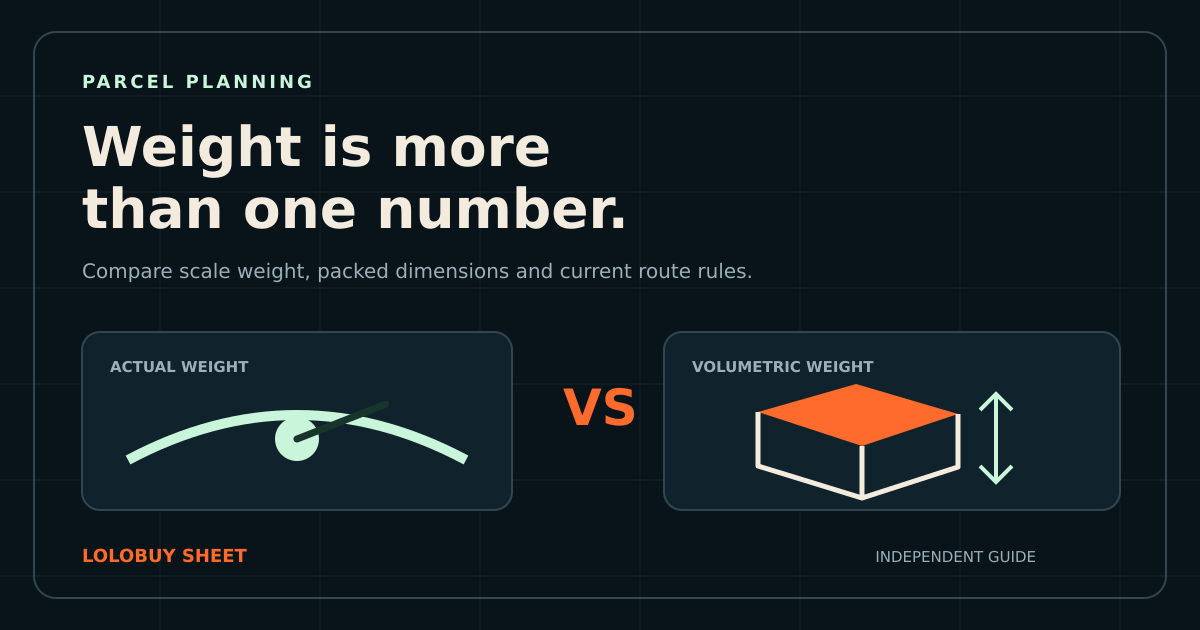
A footwear order can occupy more space than its scale weight suggests. Ask for the dimensions of the outer package once the agreed protection and retained retail boxes are included. Compare the actual weight with the dimensional result required by the selected route. Do not apply a divisor from a different carrier simply because it appears in a shipping discussion.
As an arithmetic example, a 45 × 35 × 25 cm parcel has a volume of 39,375 cubic centimetres. Dividing by 5,000 would produce 7.875 kg if that were the route's stated divisor. The charged weight would still depend on its comparison, rounding and minimum rules. This is a worked calculation, not a quote for shipping those dimensions to Britain.
Review packing changes through their effect on the final quote. Flattening or removing a box may reduce volume, but protection for structured shoes, delicate surfaces and accessories still matters. Ask what replaces the removed material and whether the new arrangement changes the billable increment. A smaller package with unchanged freight and poorer protection is not an automatic improvement.
Compare consolidation with a genuine split
Consolidation combines accepted items into a parcel. Its advantage is not simply having fewer tracking numbers: it may avoid repeating a minimum freight charge or a packing step. However, one bulky retail box can determine the size of the entire shipment, and an ineligible item can limit the routes available for all the contents.
For a proposed split, write two complete parcel records and obtain two quotes. Add both freight totals and any separate packing costs. Compare those figures with the consolidated quotation using the same final destination. Include the practical burden of two deliveries, two sets of tracking events and potentially separate document requests.
Split because the physical contents or service requirements justify it, not to disguise value or assume a tax outcome. For example, an accepted clothing order and a pair still awaiting seller resolution have different readiness dates. Shipping the accepted items first can be a scheduling choice even when it costs more. Label the reason clearly so it is not mistaken for a proven saving.
Read route and timing information carefully
For every eligible option, record the stated transit range, its starting event, the tracking arrangement and any compensation conditions. Ask whether the displayed range begins at payment, dispatch from the warehouse or carrier acceptance. These dates can differ. A quote that looks faster may simply describe a shorter part of the journey.
Keep purchasing and warehouse time outside a carrier transit estimate unless the service explicitly includes them. Seller delays, QC questions and packing revisions occur before international handover. Once a parcel is moving, distinguish a departure scan from arrival, clearance and local delivery. A single tracking milestone cannot establish that the remaining steps have finished.
Check receiving arrangements at the UK address before dispatch. If someone must accept the parcel or the building has specific delivery instructions, provide information the carrier can use. Monitor genuine requests for documents or payment through verified channels. Save the original notice when seeking help; paraphrasing it can omit the reference needed to investigate.
Make the final choice with a saved record
Approve the parcel only when the contents, postcode, route and packing instructions agree. Keep photographs and order references until the items arrive and any outstanding issue is resolved. Save the final dimensions, actual weight, charged weight if shown, price breakdown and applicable service terms. These records make a later difference easier to explain.
When the parcel arrives, inspect the outer packaging and contents before discarding useful evidence. Check that every item and retained accessory matches the saved list. If something is missing or damaged, follow the applicable reporting process and deadlines with a clear description, rather than relying on a general complaint about the shipping line.
For the next order, compare planned and actual costs stage by stage. Identify whether the difference came from dimensions, packing, a payment charge or import handling. Avoid turning one successful delivery into a permanent promise about UK shipping time. Your own parcel history is most useful when it preserves the conditions that produced the result.
Related buying guides
Continue your research
Open a matched product, then verify the live details
Product availability, options, prices and seller notes can change. Use the catalog to find an item, then make the purchase decision from the current page and your saved order record.