
Reader summary
Four points to keep
- Compare routes using the same destination, contents and packed dimensions.
- Separate international freight from purchasing costs and import charges.
- Check current US import treatment instead of assuming an old low-value exemption.
- Start the delivery timeline at the stage actually covered by the carrier estimate.
FACT-CHECK NOTE
Start with a parcel record for your US address
Enter the destination country and full ZIP code before comparing routes. Keep the state, city and delivery address consistent across every estimate. A quotation for a different destination or an incomplete address is not a useful benchmark for your own order. Record whether the delivery address has any access or receiving constraints that the selected carrier must accommodate.
Next list the exact items ready for shipment. Include quantities, materials where known, packaging choices and any contents requiring special acceptance. Do not assume every warehouse item can travel on every available line. A route shown for ordinary clothing may have different restrictions for batteries, liquids, unusually large boxes or other controlled contents. Ask about the particular item rather than choosing an approximate category to obtain a lower quote.
Keep undecided purchases out of the comparison. If one pair of shoes still needs a size-label photograph, mark it as awaiting review. Combining an uncertain item with accepted ones creates a moving target: dimensions, packing arrangements and eligible routes can all change. A saved parcel record makes it clear what the quote actually covers.
Build the cost from separate stages
A useful LoloBuy shipping cost USA budget distinguishes money already committed from money still to be paid. Record the item price and any domestic delivery, then note inspection or packing services you have actually selected. Add the international freight quote separately. This prevents a low item price from disguising an expensive parcel and stops an existing payment from being counted twice.
For each route, capture the quote currency, the time checked and the parcel inputs. Copy any displayed handling, packaging, fuel, remote-area or payment charges where applicable; do not invent a fee merely because another carrier uses one. If a charge is unclear, obtain a written explanation before comparing that route with a price that includes it.
Leave a distinct line for import duties, taxes and clearance-related charges that are not expressly included. A route name or promotional label is not an itemized account of who pays which charge. Ask what the quoted price covers, who handles the declaration, and what evidence you will receive. This is a budgeting checklist, not an estimate of the tax due on your individual shipment.
Compare actual and dimensional weight
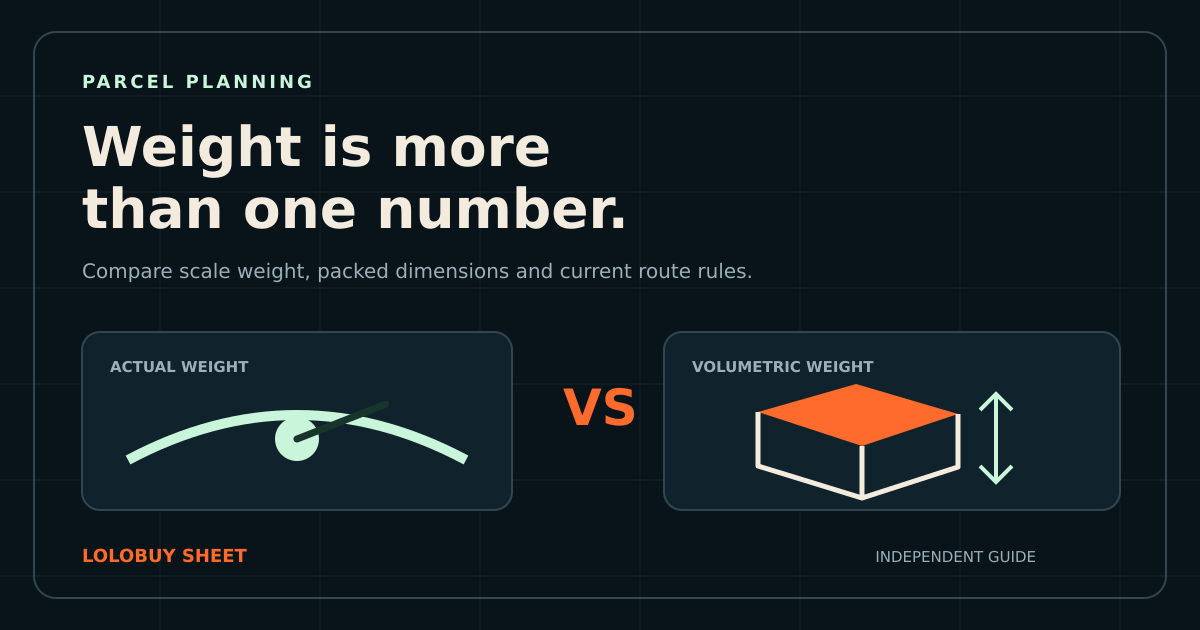
Actual weight is the packed parcel on a scale. Dimensional weight represents the space it occupies. Some routes compare the two and bill the greater value, with their own rounding rules or minimum charge. The relevant dimensions belong to the outer shipping package, including protection, rather than the shoes, garment or retail box considered in isolation.
For an illustrative parcel measuring 40 × 30 × 25 cm, the volume is 30,000 cubic centimetres. If a route uses a divisor of 5,000, the dimensional weight is 6 kg. With an actual weight of 4 kg, a greater-of-the-two rule would start from 6 kg before rounding. This example explains the arithmetic; it is not a current LoloBuy rate or proof that your route uses that divisor.
A smaller box helps only when it changes the billable result enough to affect the quote. If both packing arrangements fall in the same charged increment, removing a retail box may save nothing. Request the revised packed measurements and compare the resulting quotation. Retain enough protection for the contents instead of treating the lowest volume as the only objective.
Read US import information before committing
Old discussions may assume that purchases below a particular value always enter the United States without duty. CBP announced the suspension of duty-free de minimis treatment for covered shipments from all countries effective 29 August 2025, with separate operational guidance for international mail. An older shopping post is therefore an unsafe basis for a current landed-cost calculation.
Check the current CBP guidance and the carrier's requirements for the actual shipping date. The treatment of an order can depend on its contents, origin and entry method. Keep an accurate purchase record and describe the goods truthfully. Do not change values or split a parcel to misrepresent a transaction. If the route documentation does not make the process clear, seek clarification before dispatch.
Organize the invoice, payment evidence and item descriptions together with the parcel reference. This record is useful if the carrier asks a question or a charge needs checking later. Sending a concise, consistent record is easier than reconstructing several marketplace orders from memory while the parcel is already in transit.
Interpret shipping time as a sequence
A LoloBuy shipping time USA estimate needs a clear starting point. Purchasing, seller dispatch, arrival at the warehouse, inspection, repacking and carrier handover are separate stages. An international transit estimate does not automatically include all of them. Record the earliest stage your items have actually reached before deciding whether a quoted delivery range is relevant.
After handover, read tracking as a series of events: acceptance, departure, transport, import processing, local handoff and delivery. A label created electronically is different from a physical acceptance scan. Similarly, an arrival notice does not necessarily mean customs processing has finished. Save the exact status and timestamp when asking support about a delay.
Work backwards from a meaningful personal deadline, but leave room for uncertainty. A gift needed on a fixed date requires a different decision from clothing you can receive at any time. If the available information cannot support the deadline, do not convert the fastest advertised range into a promise. Decide whether waiting, reducing the order or buying locally better meets that need.
Compare eligible routes on the same terms
Make a short comparison record for each eligible route: packed weight and dimensions, quoted total, stated transit range, tracking arrangement, import-charge responsibility and compensation conditions. Two prices become meaningfully comparable only when they refer to the same contents and address. Check whether the estimate expires or changes after the final packing measurement.
Read exclusions before assigning value to insurance or compensation. A named service may have limits, documentation requirements or a claim window. Save the actual terms associated with the selected parcel. A higher quoted amount is not automatically better protection, just as the cheapest route is not automatically unsuitable. Decide which differences matter for your contents and tolerance for delay.
If you revise the parcel, repeat the comparison. Adding one bulky item can change dimensional weight even when the extra scale weight looks small. Splitting an order can introduce another minimum shipping charge and another packing fee. Compare the complete single-parcel and split-parcel totals before treating either arrangement as a saving.
Approve, save and follow the delivery
Before payment, confirm that QC issues are resolved, the US address is correct, the selected line accepts every item, and the quote uses the final packing choices. Save the parcel identifier, item list, measurements and payment summary together. This final check connects your earlier planning with the package that will actually be shipped.
After dispatch, monitor the carrier's official tracking information and respond to genuine document or delivery requests through verified account channels. If an update is unclear, ask about the specific event rather than requesting a new delivery promise. Keep any import invoice and final delivery record with the original order details.
Use the completed shipment to improve the next estimate. Compare the original inputs with the final charged weight and identify whether packing, added items or a route rule caused a difference. One parcel is evidence about that parcel, not a universal US shipping rate. A careful record makes the next decision more informed without pretending that conditions will stay identical.
Related buying guides
Continue your research
Open a matched product, then verify the live details
Product availability, options, prices and seller notes can change. Use the catalog to find an item, then make the purchase decision from the current page and your saved order record.